Wednesday, September 26, 2007

The Disciplined Heart - Chapter 5 (Part 2)

The Disciplined HeartHaving looked briefly at romantic love, the second part of chapter 5 deals with married love. As previously mentioned, Simon differentiates the two on her concept of destiny, with marriage moving forward to create a third dimension - a shared destiny - in addition to the individual destinies of each partner.

In exploring marital love, Simon draws heavily on the philosopher Robert Nozick's concept of a we. This we is created when two people unite to "form and constitute a new entity in the world" (123). This entity has several defining characteristics, including a shared identity, being seen publicly as a couple, giving up the right to make certain decisions unilaterally, mutual possessions, etc. Of particular import is the reshaping of identity to include being part of a particular couple. This implies monogamy, as "[i]n the strong sense of the notion of identity involved here, one can no more be part of many wes which constitute one's identity than one can simultaneously have many individual identities" (124). This deep interlocking of destiny, identity, body and life is best expressed in the institution of marriage. And I would say, best confined to the institution of marriage.

However, this merging isn't total. In a healthy marriage, there ought not be an attempt to completely fuse the two people (Simon uses the ancient Stoic image of wine and water poured together to create a new liquid), but rather some element of separateness must remain. "[W]ithin marriage there is a shared sense of identity that cannot be undone without damage to one's sense of of self, [but] there should also be a sense of remaining two whole and healthy persons within the union" (126).

As with identity, so with destiny. While there is a merging of destinies, there also remains a dialectical tension with the destinies of each partner, as they are not completely absorbed into the mutual destiny.  Enter imagination, which will (hopefully) "reveal a vision of one's own destiny as shaping, being shaped by, and unfolding in and with the destiny of one's spouse" (127).

This linking of destinies, while wonderful and necessary, can be harmonious, but also inevitably entails "being wounded by the other's wounds and being a hostage to the other's fortunes. There will be no we... without suffering and a certain dying to self" (131). The question becomes whether the suffering is destructive or redemptive.

To illustrate, she takes a fairly detailed look at William Stegner's novel Crossing to Safety, which looks at the intersecting lives of two married couples, the Langs and the Morgans. I don't have space to recount it all here, but suffice it to say that one marriage involves fiction-making in that the wife, who has a powerful personality, does not endorse the destiny of her husband and has created one for him  that is not in keeping with who he is, making the creation of a healthy mutual destiny nearly impossible. There is love, yet the husband admits that it is bondage. But nonetheless "a slavery [he] couldn't bear to part with" (136). Despite the good in the marriage, I get the sense from her summary that both partners have somehow lost some of the best in themselves through the prolonged confrontation.

The other couple, the Morgans, suffer as the wife is crippled by polio, severely altering their lives. Here, though, the husband says (after being told by the other man that they are both chained by their marriages): "But what he doesn't understand is that my chains are not chains, that over the years Sally's crippling has been a rueful blessing. It has made her more than she was; it has let her give me more more than she would ever have been able to give healthy; it has taught me at least the alphabet of gratitude" (140). In this case the suffering has been redemptive. Both the individual and the shared destinies were shaped and altered, allowing each partner to move more fully into him/herself.

Again here it seems that we are faced with two key components for love: knowledge and humility. These things, coupled with creative insight into the the other's destiny, seem to mark all brands of love as described by Simon.

Read More...

Saturday, September 22, 2007

Living Biblically

Year of Living BiblicallyA.J. Jacobs has recently published a book called The Year of Living Biblically: One Man's Humble Quest to Follow the Bible as Literally as Possible. Jacobs, an agnostic, carried around a list of all the Biblical rules and prohibitions to follow, and even kept some pebbles in his pocket for impromptu stonings.

In an interview with Newsweek, he talks a bit about the experience. I was fairly unsurprised by his conclusions: religion provides a structure that can serve as an antidote to the sheer volume of choice we are faced with, the Bible is okay as long as you pick and choose the 'good' parts, behavior influences thought, the Bible encourages gratitude, etc. I guess what I found more interesting is how completely he misses the point of living Biblically, even after so much reading and study (I presume). In my mind to live Biblically is to serve God and live under grace with the aid of the Spirit. Not to embrace an anachronistic legalism devoid of faith. It makes me kind of sad, actually, that he sought to understand Christianity by following the law, but didn't discover the fulfillment of the law in Christ and the freedom that entails.

Read More...

Friday, September 21, 2007

The First Mitt is Complete!

The Fiddler Today we took a little field trip to the Gianadda gallery in Martigny to see the Chagall exhibit, which was absolutely fantastic. The Fiddler on the left was apparently the inspiration for Fiddler on the Roof. Who knew?
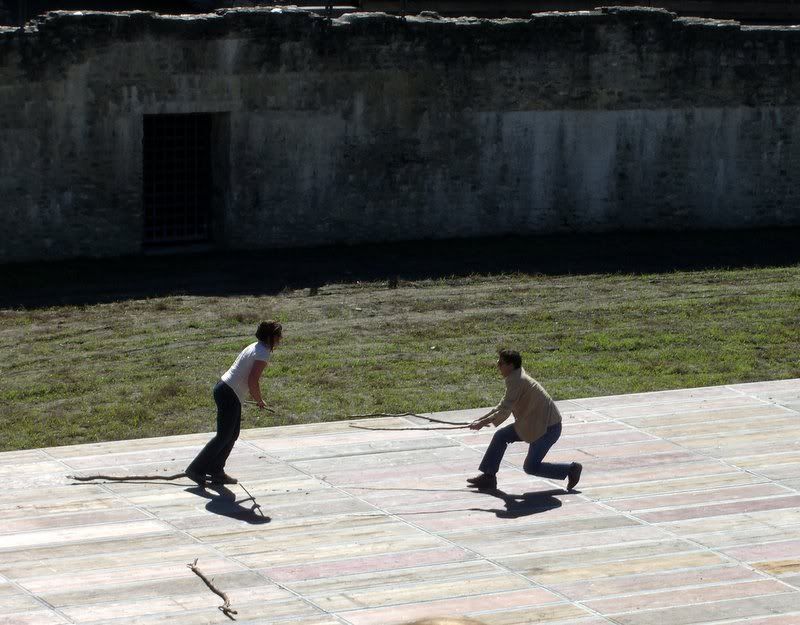
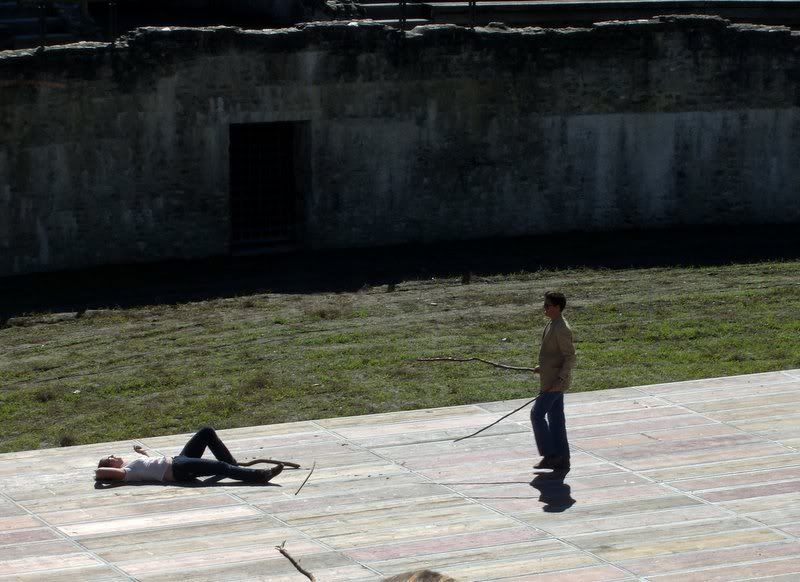
After we toured the gallery and the sculpture garden, we walked across to the old Roman amphitheatre for lunch, where Vincent and Carla entertained us with sticks (see below), and then several of the girls did a little gymnastics expo.

The Battle is On Sweet Death

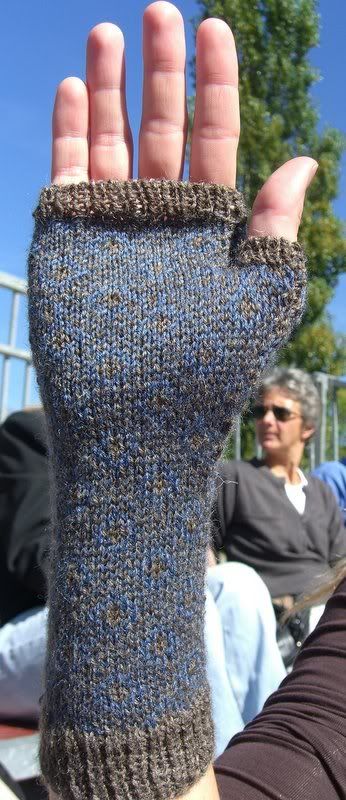
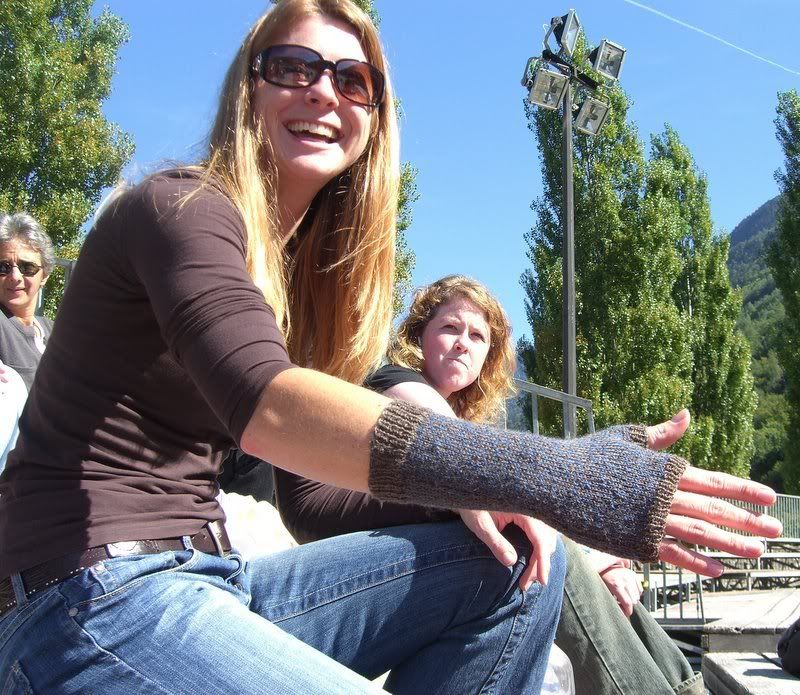
Palm SideWhile that was taking place in the arena, I chatted with some of the girls in the stands and finished up the first of my new pair of Endpaper Mitts. It's difficult to see the colorwork here (check out Eunny's site for a better view of the detail), but I'm very excited about them...

Hurrah!

Read More...

Thursday, September 20, 2007

A Quick Update

Sorry that my blogging has been so sporadic of late. This term has kept my days and my mind pretty full, and it's been difficult to keep up with everything. But it's been full of really wonderful things: a fabulous group of students, the discovery of a few new authors and ideas, and whenever I can spare a moment, knitting.

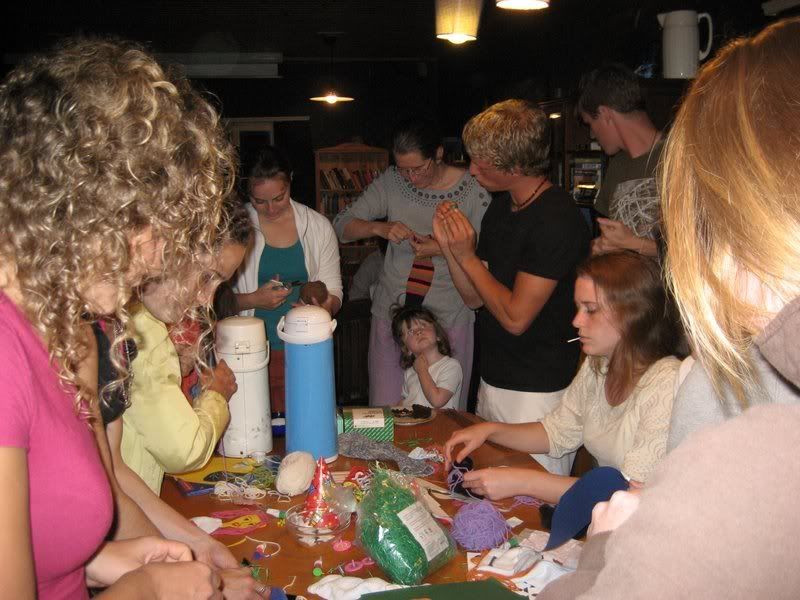
Puppet Making On the l'abri front, a few highlights so far... last Sunday I did my sock puppet theater high tea and this group proved exceedingly creative. I think my favorite was directed by Chris (who also blew us all away last summer), whose team did a spoof of Monty Python and the Holy Grail seeking the grail at l'abri. There was also a version of Romeo and Juliet, a scene from l'abri in which another Gregg did a Greg Laughery impersonation that was just frighteningly dead on, Kay and I following the students to El Gringos (to make sure that the blue (boys) and red (girls) didn't make purple, apparently), and some other ones that are currently escaping my memory. I wish I had more pics and video, but my camera ran out of juice just as we were getting started.

I also did a seminar on The Disciplined Heart, and I think I'll do another one soon. All of the other typical day fillers are going swimmingly - cooking, formal meals, tutorials, prayer meetings, and the rest. I'm really enjoying the girls I get to tutor, and I'm thrilled that they are all here the full term and so we're really getting a chance to know each other.

On A Hike

A goat along the way Days off have been fun, but fairly solitary so far. It's either been crummy weather so I've holed up with a book, or gorgeous weather so I've gone for some pretty amazing hikes. Last week I went to Vevey with Renea to do some shopping and just hang out by the lake, which was super fun. We went to Manor and I practiced my self-control by browsing the yarn section and not buying.

Speaking of yarn, I've also been finishing off lots of half completed items, including a couple of sweaters, a few pairs of socks, and some mitts. Of course, I've also cast on some new projects. A hoodie cardigan for Kay, some more mitts, and the ever-present pair of socks (handy for lectures).

That's a seriously abridged version of life right now, but it will have to do. I've been thinking a ton about spiritual disciplines, especially praying and fasting, and I'm hoping to get some thoughts up here about it soon. I'm going through a period in which my mind is almost too full, if such a thing is possible! It's making it difficult to write anything, as I'm tackling lots of things at the same time and I don't feel as though I've processed much of it to a shareable point. Hopefully soon!

Read More...

Tuesday, September 11, 2007

The Disciplined Heart - Chapter 5

The Disciplined HeartWhen I think of love, my mind usually jumps first to romance, so I had to force myself not to skip ahead to this chapter on romantic and marital love. I'm going to split the discussion here into 2 parts (romantic and marital love), as trying to condense without totally losing the point is tricky and I want to try to do at least a little justice to Simon's thinking on the topics.

The first question is, of course, are romantic love and marital love two different things? In the context of destiny, Simon seems to say yes. Romantic love, when seen as a preamble to marriage (which it may or may not be) still involves two unique destinies, whereas in marriage the added dimension of shared destiny comes into play.

So what is romantic love? In Simon's view it involves seeing the other as embodying ideal manhood or womanhood. This idealization is complex, and could very easily lend itself to fiction making. Particularly if we buy into the standards set by popular culture, which are largely oppressive. I don't know that we can fully escape cultural ideals of masculinity and femininity, but this seems to be a point at which it would be crucial to seek awareness and dialogue with scriptural renderings of manhood and womanhood to find a better vision. Ideal manhood/womanhood is also highly person relative... thank goodness we're not all looking for the exact same thing!

A healthier sort of idealization, fueled by imaginative insight into the other's destiny, “attributes to the beloved positive features that the beloved in fact has and knows about, contributes to increased self-awareness by making the beloved aware of positive features that the beloved previously did not know he or she had, or motivates the beloved to acquire positive characteristics on order to grow into the lover’s view of him or her.” (116)

Again, love requires some degree of knowledge of the other person as they are. To avoid false idealization, we must be sufficiently aware of the capabilities and desires of the other person - their own view of their destiny. For example, my own concept of ideal manhood includes high intelligence and pursuit of knowledge. So if I meet a great guy who is super smart but hates the book learnin' (I'm not saying that intelligence is determined by reading, but I like the bookworm sort), the mismatch between ability and proclivity would force me to either reshape my ideal or take a pass on the relationship. Otherwise it's highly likely that I'll create a no-win situation, forcing the guy to either pretend to be something that he's not or live with the knowledge of being a disappointment in that area. Ditto if a guy were to include a superabundance of docility in his ideal of womanhood. There, the capability issue would come to the fore.

This brings us to another important point that Simon makes: In a healthy romantic relationship, both the ideal and the beloved undergo growth and change. The dynamic would hopefully work out so that as you grow to admire more things in the other, your ideal would be shaped by him/her, while at the same time your appreciation of those qualities would encourage him/her to move more fully into them. Of course, as my dad likes to say, we all have our outhouse ways, so the negative qualities definitely factor in. How isn't particularly addressed by Simon, which is a sad oversight as I can't imagine any love that doesn't deal with the realities of our weaknesses. That would be merely illusion.

So next week we'll look at marital love, and as a precursor to that I'll leave you with a quote from George Eliot's Middlemarch:

Whatever else remained the same, the light had changed, and you cannot find the pearly dawn at noonday. The fact is unalterable, that a fellow-mortal with whose nature you are acquainted solely through the brief entrances and exits of a few imaginative weeks called courtship, may, when seen in the continuity of married companionship, be disclosed as something better or worse than what you have preconceived, but will certainly not appear altogether the same.

Read More...

Friday, September 07, 2007

Talk Like A Pirate Day

Apparently, September 19th is Talk Like A Pirate Day. I know a few of you love the swashbucklers, and now Cafe Press has a whole line-up of pirate swag for you. My personal favorite is this shirt...

Surrender Yer Yarn

Read More...

Thursday, September 06, 2007

New iPods Unveiled

Apple announced new versions of the iPod yesterday... including a 160GB model for $349 (!!), the Nano with video, and a model with a touch screen, as well as slashing the price of the iPhone by $200.

It's a sad truth that the second I read the news, my fully functional 80GB version looked a little less shiny. Sigh.

Read More...

Saturday, September 01, 2007

St. John's Bible

Call to DiscipleshipJohn FrontispieceSt. John's has commissioned a project to complete a hand written and illustrated Bible - the first one made since the invention of the printing press. Now, after 9 years and about  4 million dollars, the project is almost complete, lacking only the final volume. And it's gorgeous!

Click here to see some images from Newsweek, and here for the image gallery on St. John's website.

Read More...

Friday, August 31, 2007

Mother Teresa

clip_image002[2]

I am told God loves me — and yet the reality of darkness & coldness & emptiness is so great that nothing touches my soul.   --Mother Teresa

Time Magazine has an article about Mother Teresa and the new book of her letters to her spiritual confessors over the years, Come Be My Light. Many of her communications reveal a deeply felt absence of God, and her persistence in her faith and work in light of it is all the more astounding.

Most (all, I suspect) of us experience what Richard Foster calls a "Sahara of the Soul" at one point or another, although gratefully most of them seem to last for less than the 50+ years of Mother Teresa's.  I find these letters so encouraging, as I continue to grapple with my own doubts and the inevitable times when I feel like I'm talking to the air.  A similar sentiment was expressed by many in the article. Rev. James Martin says of the book, "It would be a ministry to people who had experienced some doubt, some absence of God in their lives. And you know who that is? Everybody. Atheists, doubters, seekers, believers, everyone." (See Also: Brian McLaren)

On the other side is Christopher Hitchens, an outspoken atheist, who reads the letters as additional evidence of the profound idiocy of faith:  "She was no more exempt from the realization that religion is a human fabrication than any other person, and that her attempted cure was more and more professions of faith could only have deepened the pit that she had dug for herself." (See Also: Sam Harris) There is also the psychological analysis, that "she punished herself with a crippling failure to counterbalance her great successes."

The overwhelming lack of feeling of closeness with Christ in Mother Teresa's life suggests that perhaps we should re-examine what faith is. Most know that it's not just a feeling, but how do we live our lives when the feeling isn't there? And what constitutes sufficient feeling? Rev. Brian Kolodiejchuk, who put the book together, "thinks the book may act as an antidote to a cultural problem. 'The tendency in our spiritual life but also in our more general attitude toward love is that our feelings are all that is going on,' he says. 'And so to us the totality of love is what we feel. But to really love someone requires commitment, fidelity and vulnerability. Mother Teresa wasn't 'feeling' Christ's love, and she could have shut down. But she was up at 4:30 every morning for Jesus, and still writing to him, 'Your happiness is all I want.' That's a powerful example even if you are not talking in exclusively religious terms.'"

Personally, I'm grateful for the example and look forward to reading the book. As often as we talk about doubt, it is rare to have someone with such great spiritual maturity or in leadership be so open about their own struggles, except in a very general way. (See Also: Kamp Krusty) I should also mention, though, that Mother Teresa herself wanted these correspondences destroyed, but her wishes were overruled by the church. That decision is a whole other question, and while I'm grateful that they are being made available, I don't know what I think of it.

Read More...

Thursday, August 30, 2007

OMG! So Interesting!!

Encouraged by a new style guide to use exclamation points liberally in e-mail correspondence, an article in Slate today points out their original use:

A relatively recent addition to the punctuation clan, it first appeared in print around 1400 and was known until 1700 as a "mark of admiration," though admiration in this case meant something like "wonderment" (of a religious variety). Some scholars believe it derives from the Latin Io (meaning joy). Io, the theory goes, might have been rendered with its second letter under the first, thus producing an exclamation mark.

and some of the sad effects of the medium itself:

For centuries, the act of writing mandated a tremendous exertion of labor, so that scribes committed to the page only texts of supreme import. (Imagine a team of tonsured monks toiling for decades on an illuminated manuscript that read, "WTF … c u l8r?") For centuries, that which was written had to deserve to be written. Today's technology, however, allows us to transmit doodles of thought (e.g. "Running 10 mins late") we never would have deemed worthy of print. It's not that we know we aren't writing well—and so tack on some exclamations!!!—it's that we know what we're saying doesn't deserve to be written at all.

Read More...

Wednesday, August 29, 2007

Just For A Laugh...

Check out The 10 Most Regrettable Celebrity Commercials

Read More...

Tuesday, August 28, 2007

The Disciplined Heart - Chapter 4

The Disciplined HeartThis chapter on friendship begins with the task of trying to get to some definition of 'friend' from which to start. After all, it is a term we tend to use loosely, referring to everyone from people we see at work to the folks who were part of our past to our current intimate friends. How do we narrow it down? Simon suggests a starting point, outlining some features that are (ideally) part of a significant friendship: "A sense of equality and mutuality, concern for each other's welfare, willingness to help when needed, shared interests and activities, shared values and principles, shared history and memories, open communication, and intimate connection." (89) "Intimate connection" is an interesting one for me, as I don't have the luxury of physical proximity to most of my dearest friends. There is a short article in Philosophy Now  that offers a positive spin on how email/the internet allows friendship to grow and thrive in new ways. What do y'all think - how significant can a friendship be when you're only face to face once in a blue moon?

So then, how does friendship differ than neighbor love? Well, the use of imagination is markedly different, for starters. While in neighbor love we need not have " any clear idea of what his destiny is beyond the general Christian belief that it will somehow involve Christlikeness," (89) friendship requires knowledge of the other and an affirmation that their own vision of their destiny is substantially correct. In addition, it requires a commitment to help them achieve their vision, supporting them and encouraging them and in general becoming a source of strength for them. All of this implies that friends must not be "so completely fictions of their own making that they have not a clue of their own destinies." (96) They (and we) must be sufficiently self-aware.  We all engage in some degree of fiction-making about ourselves, but "[t]o the extent we [do so], we are strangers to ourselves and others." (107) This is true in our relationship with God as well as with other people.

If we take an affirmation of destiny (used here as God's intention for our lives, our "true story") as one of the central ways of loving a friend, does this mean that Christians can only be friends with other Christians? Or that non-Christians in general can't have true friendships? To this charge, Simon says no: "Spiritual or moral growth need not be the focus of a genuine friendship, but growth in the good will be its result." (103) This good could be a love of art, a passion for science, or whatever. Even in Christian friendships, it "need not look like two-person religious support groups. The friends may spend more time talking about literature or sharing the silence of a trout stream's banks than engaging in 'God talk.'" (103) Spiritual improvement is not the aim of friendship, but rather it is to help them fulfill their conception of their destiny. I think the "their" there is important. Friends have the difficult task of speaking sometimes hard truths into the relationship and sharing insight, but ultimately "one wants the story that one's friend lives out to be his own." (105)

So how do you respond when a friend's story begins to diverge from your own? Or when when you simply don't agree with a person's conception of their destiny? I'd be curious to hear thoughts about how to deal with these things... how to discern when to speak and when to maintain silence.

It seems evident, even from this very superficial overview (me, not the book), that, as Aristotle claimed, "a wish for friendship may arise quickly, but friendship does not." (93) To have understanding and acceptance of the other person requires that you know them fairly well, and establishing trust and intimacy requires time - for some of us, a lot of time!

To end, a quote from The Great Gatsby, which is the novel she uses to illustrate friendship, in which Nick describes Gatsby:

He smiled understandingly - much more than understandingly. It was one of those rare smiles with a quality of eternal reassurance in it, that you may come across four or five times in life. It faced - or seemed to face - the whole external world for an instant, and then concentrated on you with an irresistible prejudice in your favor. It understood you just as far as you wanted to be understood, believed in you as you would like to believe in yourself, and assured you that it had precisely the impression of you that, at your best, you hoped to convey. (91)

Read More...

Saturday, August 25, 2007

The Perils of Writing

I won't claim to know much about the Jose Padilla trial that prompted this essay, but Garrison Keillor has written a wonderful and humorous piece on the dangers of writing for unknown readers and the hazards of being (mis)interpreted....

We are invisibly linked through words I have written, and yet the meaning of those words, as determined by a jury of twelve men and women good and true, could be far, far from what I intended, and as I sit there at the defense table in the Miami courtroom, smelling the musky cologne of your idiot attorney, looking past him at you, you wretched cretin, as the linguistics expert for the state, a tall bunheaded woman with a Ph.D. in literary deconstruction, testifies that the subtext of my column in question was a command that you plant an explosive device in the heel of your cowboy boot and try to run through airport security hollering "I'm a-comin', Mama!" I am going to think back on my life and wish I had become a gardener. Nobody was ever indicted for watering plants.

Read More...

Friday, August 24, 2007

Free Theological Classes

Reclaiming the Mind is starting new theology courses on September 9th (HT: Evangelical Outpost) that are free for the self-led online version, if anyone is interested...

The Theology Program is a program of Christian theology (study of God) and apologetics (defending the faith) created with all believers in mind. TTP seeks to give people who may never have the time, ability, or circumstances that allow them to attend full-time seminary the same opportunity to study the great and rich Christian heritage of truth. Here, you will learn theology historically, biblically, and irenically (in a peaceful manner). The contents of TTP are created from a broadly evangelical perspective, engaging other traditions in a persuasive yet gracious manner. In short, we seek to help people think theologically by understanding what they believe and why they believe it.

Having never taken a course from them, I don't know what they're like, but I thought I'd pass along the link.

Read More...

Thursday, August 23, 2007

The Joy of Reading

I just finished reading Neil Postman's book Amusing Ourselves to Death, which talks about some of the problems inherent in an image based culture (as opposed to a print based one). It was alarming to have laid out so clearly the ways in which our TV saturated society has reframed our entire epistemology over the last hundred years or so! Hopefully I'll post more on the book, but for now I just wanted to direct you to Tim Challies' recent post on the pleasures of reading, which was a great affirmation of the value of books after spending some time with a more negative critique of things.

Read More...

Tuesday, August 21, 2007

The Disciplined Heart - Chapter 3

The Disciplined Heart

In this chapter, Simon discusses neighbor love. This, of course, begs the question of "who is our neighbor?", which Jesus answered in the parable of the good Samaritan and which I will summarize here as "Everyone."

Neighbor love, like self-love, involves imagination, a creative vision into the destiny of the other. (Remembering that destiny, as defined by Simon, is that which God intends for our lives; our "true story.") We are called to do this even when there is little overt evidence that the destiny is even in progress, and we can find no easily identifiable value in the other person. But "because Christians refuse to see people from a merely human point of view (2 Cor 5:1-17), we take this exercise in imagination to be more than fiction-making." (74) Such fiction-making would result in a superficial sentimentality, which "assumes that thinking nice thoughts will solve all problems, that pretending that things are less grim than they are will somehow magically make them better." (74) It requires a much deeper transformation in our thinking, a willingness to see that appears to be pure foolishness much of the time.

There is a crucial distinction she is making here that I think is important to point out, especially because it is a trap I find myself falling into: We are not loving others in spite of what we see, thereby affirming the unworthiness of the object on at least some level, but instead we are perceiving the actual value of the other person. (There is a whole discussion she goes into on the popular Christian dichotomy between agape and eros, and proposes something of a synthesis between them (caritas), akin to that which Augustine and Calvin talked about. An interesting read, but I won't get into it here.)

The relationship between love and humility comes to the fore again as we look at the flip side: our willingness to receive love. Most of us have experienced how hard it is to accept love that we don't feel we deserve. As C.S. Lewis says in The Four Loves, "how difficult it is to receive, and to go on receiving, from others a love that does not depend on our own attraction!" Plus, many of us are sometimes overwhelmed a by a sense of guilt and shame. There is a certain pride in hanging onto that. For me, accepting the grace and forgiveness of God was one of the hardest things I've ever done (and continue to do). To accept the loss of myself as my own savior was tough, but ultimately freeing. And if it's that difficult to accept from God, how much more so from other fallen people! But it seems here that a similar 'giving up' is required for us to participate in a Christian vision of neighbor love. It would be a very condescending version of 'love' to give to all and accept from only a few. It requires much more imagination to, for example, participate in the good act of volunteering at a soup kitchen and see the street people there as having something important to offer you by their love, and not just you coming in to offer something to them.

To love people is to respect them... I'll finish with this definition of respect from a footnote that quotes Paul Wadell summarizing Enda McDonagh on page 74 (how's that for a convoluted reference?)

To respect another person is to take whatever time is necessary to see their goodness. Respect literally means to ‘look again,’ to ‘take a second look.' It means we cannot settle for first impressions, or casually dismiss people from our lives. To have respect for someone is to look far enough into the person to see their goodness, even if that goodness is more a promise than a fact. We respect them when we call them to this goodness and commit ourselves to eliciting it.

Read More...

Sunday, August 19, 2007

I Know I Shouldn't Laugh...

...but there is a story in the IHT today about an Australian woman killed by her pet camel when it attempted to mate with her.

In other, less cringe-inducing  news, it appears that J.K. Rowling is at work on a new crime novel. I can't wait to see what she does!

Read More...

Saturday, August 18, 2007

The Key Demographic in 2008


In The Know: Candidates Compete For Vital Idgit Vote


I ♥ The Onion

Read More...

Tuesday, August 14, 2007

The Disciplined Heart - Chapter 2

The Disciplined HeartThis chapter, " Love and Self-Knowledge", deals in large part with the danger of self-deception. She uses two stories - "The Lame Shall Enter First" by Flannery O'Connor and "Father Sergius" by Leo Tolstoy - to illustrate the depth and power of a person to deceive themself about who they are, and how this filters outward and colors the way in which other people and the world are interpreted. It is a destructive fiction-making that prohibits love. For example, in the O'Connor story the main character, Sheppard, believes himself to be a good father who provides everything his son, Norton, could need or want after his mother passed away. So when he witnesses Norton counting his coins, he interprets this hoarding behavior as selfishness, rather than "pathetic attempts of a grieving child to build some fragile security." (44) His desire to perceive himself in one way causes him to think and act in ways that generate the exact opposite perception of him by other people.

How often do we all do this? I know I certainly have some deeply held beliefs about myself that lead me to some less than generous conclusions about other people's behavior!

So how do we get to this point? Self-deception seems terribly incoherent, as we would be "both believing and not believing the same proposition at the same time." (45) Simon points to the philosopher Alfred Mele, who says that self-deception occurs when the desire for a false belief to be true causes one to look only at/for evidence that confirms the truth of the belief, or to interpret evidence only in such a way as to support the belief. It's all very subtle, really. And so convoluted and deeply entrenched in our minds that it is quite difficult to know when we're doing it!

Given the immensity of the task of knowing ourselves and the sometimes overwhelming reality of self-deception, what can we do? Well, for one thing, we must engage in the task of reflection. Self-knowledge, she claims, is intimately connected with progress in virtue. (Virtue being defined here "character traits that enhance one's ability to live out one's destiny." (41) ) To become more virtuous is to face our vices - the evil in us - and "[t]he more we reflect, the more we shall transform ourselves from being the instruments of [evil] to being [its] controllers." (58)

But reflection on its own can be a dangerous thing; our vices can influence our introspection. For example, "[m]alicious people who engage in reflection are likely to become adept at insight into other people's weaknesses, especially those whom they dislike, but may be unable to see this as itself an instance of their own maliciousness." (58) Reflection alone could in this way increase our self-deception rather than draw us closer to truth.

At this point in the chapter, I felt a wee bit despairing... how in the world can we ever cut to the truth of it all if all of our tools are dull and dangerous? Happily, there is more. Here we begin to clearly see some of the connections between love and humility: as we allow ourselves to become vulnerable enough to hear critique from our community, and also start taking steps of both personal and communal confession, that dynamic relational interplay hones us. It starts becoming easier to see where our thinking diverges from reality, and community support can be a major factor as we begin the hard work of change.

We also can't underestimate the value of the traumatic moments when we fail in a spectacular fashion. Those times disallow us the luxury of pretense, as we are faced with an obvious display of our weakness and sin. Augustine actually believed that overt sin is less spiritually dangerous than pride hidden beneath a veneer of good behavior. That makes sense to me.

I feel as though I've skipped through this chapter so quickly, I hope I pulled out at least some of the main points. I'd be really curious to hear anyone's thoughts about self-knowledge and how well we can actually know ourselves, particularly any thoughts on the good/bad points of introspection.

I'll finish it up with one last quote from the chapter:

In order to know who we are, we do not need to strive for unemotional objectivity, but rather to cultivate the correctives to pride: the faith that allows us to face the truth about ourselves because the depth of our brokenness finds its answer in grace; the hope that, though we often wander from the path, grace will make straight what we have bent; and the love, compassion, and gratitude that follow from seeing our own and others' stories as part of God's story. (65)

Read More...

Monday, August 13, 2007

Proving What We All Knew In High School

Conventional wisdom says that men not only think about sex more than women, but are also having a great deal more sex. Surveys have proven this: in the US a recent study proved that men had a median of 7 female partners while women had slept with a mere 4 guys. The only problem with the data? Apparently, it's not mathematically possible. So where does the discrepancy come in? One explanation:

"Some might be imaginary," Graham said. "Maybe two are in the man's mind and one really exists."

Read More...